

The wealthier classes do indeed have tools to reduce their taxes. And these tools are leading to a growing wealth inequality around the world, which is not a good recipe for a sustainable social order.
While many citizens are quick to speak against this trend, too often these activists do not understand how tax avoidance and tax evasion actually work. This series will provide some knowledge.
The last article of this series will offer a solution where we — the people — can identify and choose businesses that recognize that their corporate taxes provide the infrastructure to earn and enjoy profits. These are the socially conscious businesses.
Proprietorships vs. Corporations
If you understand the differences between proprietorships and corporations, you can skip to the next section. Some readers might need this refresher to understand this article better.
Proprietorships can be said to be an extension of the business owner. The business owner and the business are considered the same legal entity.
Proprietorships can be formally recognized by the government. The name is registered and a certificate is issued. Or a proprietorship may be informal with no government recognition, like a hobbyist artisan creating and selling her wares out of her home.
Partnerships are proprietorships with more than one owner. The partners may come to a formal or informal agreement about each partner’s role in this business. But partnerships have a higher tendency to fail: partners often disagree and the mechanism to resolve their disagreement is not great. Hence, partnerships are not common anymore.
Corporations are legal entities that are separate from their owner(s). A corporation has the right to hold money and buy assets. It can hire employees and enter contracts. It can take out loans. It will deal with government agencies.
The business owner(s) sets up a corporation through his/her lawyer or appropriate agency in government. There is a small cost to setting up a corporation, probably less than $1000.
The corporation comes with a rulebook, which defines the rights and obligations of shareholders and directors. The rules provide the democratic due process required for making big decisions in the corporation. If a dispute arises between the shareholders, the civil courts will look to how well the rules were followed, not who is right or wrong. As alluded to earlier, partnerships do not have this decision-making mechanism.
The biggest difference between proprietorships/partnerships and corporations is the limited liability. If the proprietorship incurs a debt that the business cannot pay, the creditors can go after the assets of the business owner. But if a corporation incurs a similar debt, the creditors can only go after the assets in the corporation. The assets of the owners (or shareholders) cannot be used to settle the debt.
Corporations are more able to find venture capital and bank loans to start the business. Investors and venture capitalists are not likely to invest in proprietorships because the rules are too vague.
Many businesses will refuse to deal with proprietorships. So most business people take the corporate path, just to expand the viable business connections.
There is one more benefit that corporations have. If the business is profitable, the business can manipulate the profits to pay a lower tax.
This article will explain this manipulation.
More on investors and venture capitalists
I should add that outside shareholders in a corporation are ultimately looking for a profitable return on their investment. They believe the business will grow and profits will be re-invested back into the business. They get their return in one of three ways:
The corporation is sold. The shareholders share in the proceeds of that sale. The corporation is still there, but under a different owner(s).
The business allows shares to be sold. Shareholders may buy shares of another shareholder. Or shareholders may sell to another person or corporation who is not a current shareholder. The price of those shares is negotiated between the seller and buyer.
The business pays dividends to shareholders. This happens after the business stabilizes and consistently earns a profit.
Bear in mind that investors want returns much higher than your average bank deposit. And they want returns that pay for the investments that sometimes fail. To put this phrase in another perspective, investors would not invest if they are only getting a bank return.
The Canadian tax schedule
I’m going to use a simplified, but reasonably accurate, model of the Canadian tax schedule to show how tax avoidance works. Other western countries will have a similar structure. Here are the tax rates for this article:
· Personal income less than $20,000 a year has 0% tax.
· Personal income between $20,000 and $200,000 has 25% tax.
· Personal income more than $200,000 has 50% tax.
· Corporate tax is 20% of profits.
· Dividend tax is 15% of dividends declared.
I need to digress here a little. Dividends come after the corporation earns a profit and pays taxes on that profit. The prevailing economic theory is that taxing dividends is “double taxation,” which — according to theorists — hurts the economy. However, rich people not paying taxes on their dividend income is politically unacceptable. So dividends have a smaller tax attached to them.
And just another digression. All those tax rates stated above mean this essay is going to get into a little math. I could have written this essay without the math, but it would not explain well how this tax avoidance works.
Scenario 1; Option 1
Let’s assume this Canadian business owner has incorporated his small business. After he pays his suppliers and employees, there is a profit of $60,000. He gets to decide whether his corporation pays him a salary or dividends or some combination of the two.
If he pays himself a salary, that salary can be used to reduce the corporate profits, which then reduces corporate tax paid. But he pays a higher personal tax.
If he pays himself in dividends, he gets the lower personal tax. But the corporate profits are higher, so the business pays more corporate tax.
First, we calculate his taxes if he pays himself $60,000 in salary.
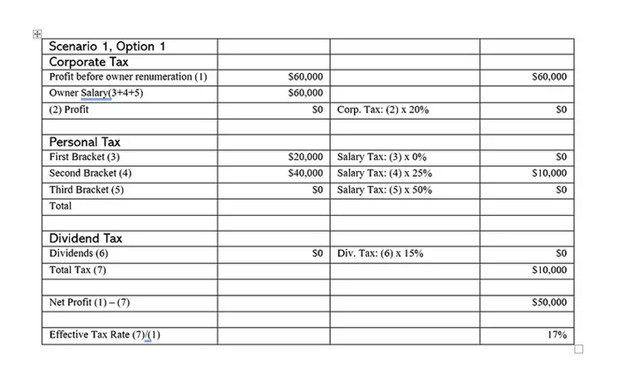
In this scenario, the business owner pays $10,000 in taxes. He keeps $50,000 of the $60,000 profit.
Scenario 1, Option 2
In this option, we assume he pays all the profits as dividends.
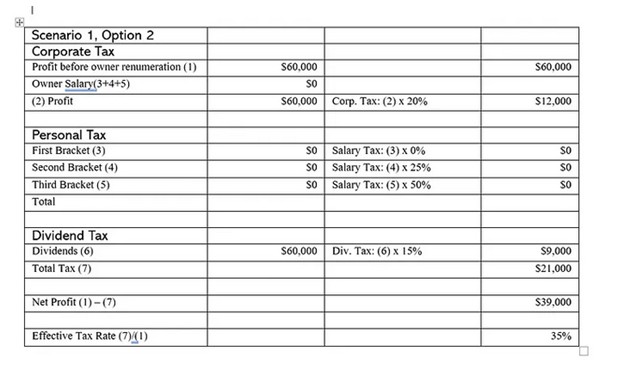
In this dividend-taking scenario, the business owner pays $12,000 in corporate tax and $9,000 in dividend tax. Total tax is $21,000. So the owner keeps only $39,000 of the $60,000 profit. Of these two options, he would chose the 100% salary option.
Scenario 1; Option 3
In this option, we put half the profit in salary and half in dividends: $30,000 salary & $30,000 dividends.
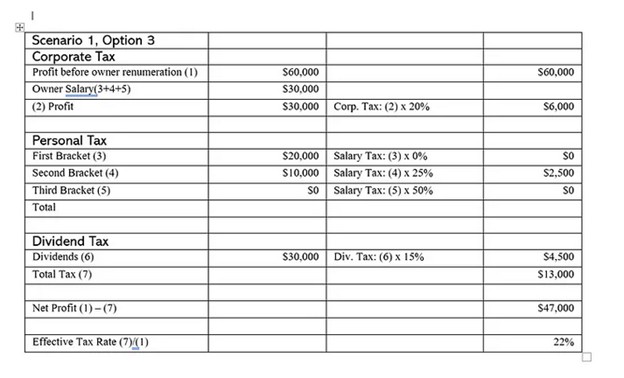
In this scenario, the business owner pays $6,000 in corporate tax, $2,500 in personal tax, and $4,500 in dividend tax. The total tax is $13,000, which means he gets to keep $47,000. While this option is better than the 100% dividend option, it is not as good as the 100% salary option.
Clearly, this business owner should use the 100% salary option to keep more of the profit for himself.
If this business owner was a proprietorship, his only option was #1. This business owners gets wealthier in the next scenario--and the options become more useful.
Scenario 2; Option 1
Now the business earns a $400,000 profit. We are going to go through a similar process as Scenario 1. The first option casts the entire $400,000 as salary.
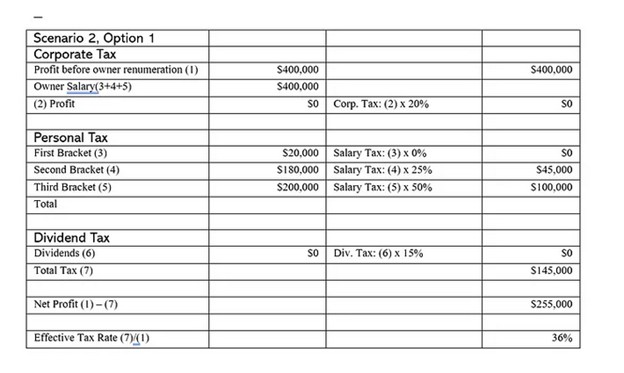
If the owner chooses 100% salary, he will pay $145,000 in tax. He takes home $255,000 of his profit.
Scenario 2; Option 2
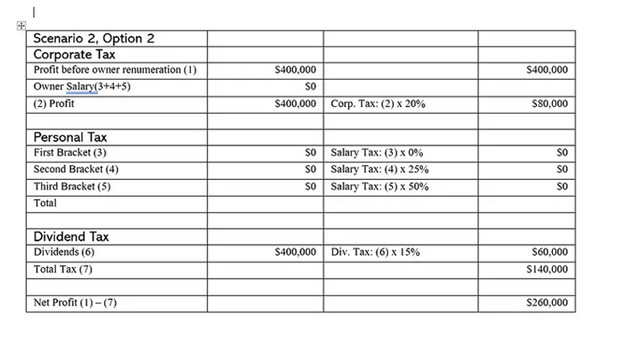
We assume he pays himself the profits in dividends.
Paying dividends is a little better than paying salary.
Scenario 2; Option 3:
Now the profit is split evenly between salary and dividends. $200,000 goes to each of the personal income streams.
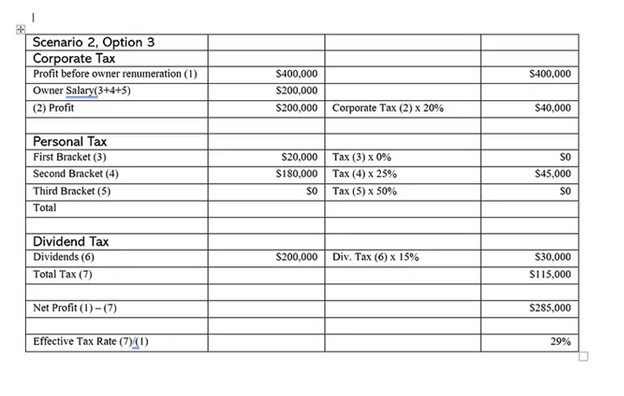
With 50% salary and 50% dividends, the owner pays $40,000 in corporate taxes, $45,000 in personal taxes, and $30,000 in dividend tax, for a total of $115,000 in taxes. This is much better than the two 100% options. In essence, the business owner gets an additional $30,000 in disposable income just by distributing his company’s profit from 100% salary to 50% salary and 50% dividends.
The business owner’s accountant will figure out the best balance between salary and dividends. The actual calculations are more difficult than what this article presents, which is why a business owner should let a professional accountant figure out the right balance.
But I think most readers get the idea. By being an incorporated business, the business owner can shuffle money legally between salary and dividends to reduce taxes. A proprietorship cannot do this. A wage or salary earner (even with a $400,000 salary) cannot do this. But the owner of an incorporated business gets this financial game to play with.
Having said this, an incorporated business not earning great profits will not get much of this shuffling money benefit. Such a business should probably pay the owner a salary. Paying dividends will most likely increase the tax bill.
How does this shuffling happen?
Here’s a short one-act play to explain how taxes in Scenario 2 are reduced by $30,000. The characters in this play are the business owner (BO) and his accountant (Acc). The setting is the accountant’s office.
Acc: Well your books are finalized. I’m seeing a profit of $400,000 this year.
BO: Yeah, we had a good year. But what about the taxes?
Acc: I’ve already run through tax calculations. If you pay yourself $200,000 in salary and $200,000 in dividends, this will reduce the overall taxes to $115,000.
BO: But the company has already paid me $84,000 in salary.
Acc: So cut yourself a salary bonus check for $116,000 and a dividend check for $200,000.
BO: But has not my year-end already finished?
Acc: Well we have four months to pay the bonus salary and dividends for the previous fiscal year. We can apply those costs to last year’s figures.
BO: Let’s do it.
Acc: OK, I will write up the meeting minute where the board of directors agrees to pay you $116,000 in a salary bonus and $200,000 in dividends. With that minute, the tax auditors have no grounds for further taxation. Cut those two checks in the next week. The deadline is coming soon.
Yes, it is that simple for this profitable business owner to get a $30,000 reduction in taxes.
Of course, this assumes the business owner owns or controls 100% of the shares in the company. If there are outside investors, they will need to be notified and have their voice heard at a board meeting. Investors will prefer more dividends over a higher manager salary. So the salary/dividend allocation requires some negotiation. Even so, bonus and dividends can be paid retroactively for a few months after year end. The tax laws allow business owners to apply the salary vs dividend calculation after the fiscal profit has been figured out.
Dave, this is so evil! Right?
Some readers will see this money shuffling between salary and dividends as something that deserves fixing. It almost seems the business exists to mostly to reduce taxes.
As a former entrepreneur, I don’t see a problem with this business owner reducing his tax bill in this way. The occupation of an entrepreneur is much different than an employee — or a manager hired to run a business unit. The entrepreneur is super committed to the business — and really can’t quit when things get tough. And nearly all small businesses go through tough times. The entrepreneur has to develop all sorts of skills that go beyond the technical aspects of the business. He must learn something about marketing, accounting, legal affairs, human resources, negotiation, and government regulations. Not that he has to be an expert in these fields, but he cannot pretend things will work out all right by ignoring these important parts of any business.
The entrepreneur must also have a vision. Sometimes that vision falls into place. Other times, the vision needs adjusting — and a successful entrepreneur needs to “watch for the signs.”
And an entrepreneur is always solving problems. Always. Many problems. I found this part of business kind of fun, but it does wear on you. I don’t want that challenge any more.
So when an entrepreneur starts a business from scratch and builds it to earn a $400,000 profit, I say a $30,000 reduction in taxes is a small break for all the hard work, hard thinking, big commitment, and solving many problems. Let’s let entrepreneurs play some little tax games with their profit.
And we should be happy this entrepreneur is still paying $115,000 in taxes.
I will talk about the dirty side of business in the next sections.
Published on Medium 2024
The Great Grocery Store Profit Capers
